
Navigation
Principles, Transactions & Basic Terms
Key Takeaway: Ground rules for financial reporting developed by professional accounting bodies (like the Institute of Chartered Accountants of India) are termed as Accounting Principles.
Learning Objectives
After studying this chapter, students should be able to:
• Define accounting principles and explain their basic features.
• Define postulates, doctrines, and axioms.
• Explain the meaning of accounting assumptions and conventions.
• Define and briefly explain various accounting standards.
• Judge various International Accounting Standards.
• Distinguish between concepts and conventions.
• Know IFRSs and their objectives.
• Explain and distinguish between transactions and events.
• Distinguish between cash transactions and credit transactions.
• Know basic terms associated with accounting.
• Know different types of assets and liabilities.
• Determine business income.
• Calculate the cost of goods sold, gross profit, and net profit.
Introduction and Meaning
In the past, when the size of a business was very small, the proprietor was the only person who needed information about the performance of the business. However, with the growing size of modern businesses, a whole host of other parties—management, potential investors, creditors, government, bankers, columnists in financial newspapers, trade associations, employees, researchers, financial institutions, and debenture holders—also feel the need for this information.
They use this information for various purposes. Because accounting communicates the required information to all these diverse groups, it is popularly recognized as the "language of business."
If each business adopted its own unique methods and principles to maintain its account books, it would lead to massive confusion in the business world. Such financial statements would suffer from inconsistency and low acceptability, rendering them unreliable and incomparable. Essentially, if accountants used whatever principles suited them best, the financial statements would become biased.
Therefore, to make financial statements meaningful, acceptable, comparable, consistent, reliable, and unbiased, it is absolutely necessary to follow a uniform system of accounting based on Generally Accepted Accounting Principles (GAAP).
"The principles, which constitute the ground rule for financial reporting are termed as generally accepted accounting principles." — Walter B. Meigs, R.E. Meigs & C.E. Johnson
These principles are usually developed by authoritative professional accounting bodies, such as:
• ICAI: The Institute of Chartered Accountants of India
• ICAEW: The Institute of Chartered Accountants of England and Wales
• AICPA: The American Institute of Certified Public Accountants
The application of GAAP provides strict standards for sound accounting practices and procedures, serving as guidelines to ensure financial statements remain true and fair.
Key Terminology in Accounting
While often used interchangeably in the context of accounting principles, it is important to understand the distinct connotations of these terms:
(a) Principles
The general rules and laws that guide accounting personnel in the process of recording and reporting. According to the AICPA, accounting principles denote "A general law or rule, adopted or professed as a guide to action, a settled ground or basis of conduct or practice."
Important characteristics of principles include:
• They are man-made and are not tested in a laboratory.
• They are based on facts and are not influenced by personal bias.
• They are relevant and cater to the needs of the users of account books.
• They are practicable, feasible, and applied without much difficulty.
(b) Postulates
Postulates consist of recognized assumptions taken into consideration during the course of recording. These assumptions are not arbitrary; they are developed as the outcome of long-standing practices over many years.
(c) Doctrines
A doctrine is a principle of belief propagated by a teacher and followed in good faith. In accounting practices, there is no strict "doctrine," but general principles or policies are often adhered to as such.
(d) Axiom
A statement of truth that is free from questioning. It generally consists of a universally accepted fact that no one disputes.
(e) Accounting Standard
The strict norms of accounting policies and practices that guide the treatment of transactions and events. Think of these as specific guidelines for dealing with specific cases.
2.1 Classification of Accounting Principles
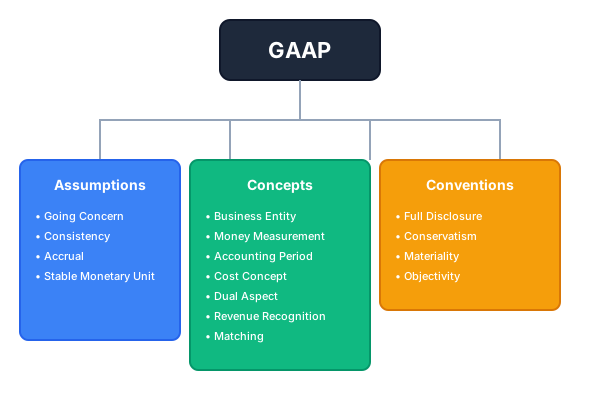
Accounting principles are frequently referred to as standards, assumptions, postulates, concepts, conventions, axioms, or GAAP. While these terms are used interchangeably, they have different meanings. For our system, we will focus primarily on assumptions, concepts, and conventions, as these have a direct bearing on how the accounting system functions.
2.1.1. Accounting Assumptions
Certain fundamental accounting assumptions underline the preparation and presentation of financial statements. Both the Institute of Chartered Accountants of India (vide AS-1) and the International Accounting Standards Committee (vide IAS-1) have stated the following as fundamental assumptions:
-
Going Concern
Accounting records presume that the business will exist for a very long time unless there is clear evidence to the contrary. The enterprise is viewed as a "going concern," meaning it will continue operations for the foreseeable future with no intention or necessity to liquidate or drastically curtail its scale of operations.
• Impact: Because of this, assets are shown on the balance sheet at their cost (less depreciation) rather than their current realizable value. Liabilities are shown at what the business actually owes, not the liquidation value. Prepaid expenses are also recognized as assets since the benefit will be utilized in the future. -
Consistency
This principle implies that once a particular accounting method is adopted, it will not be changed from year to year. This ensures uniformity and helps users intelligently interpret changes in financial statements.
• Example: If an asset is depreciated using the diminishing balance method in year one, the same method should be used in subsequent years. (Note: It can be changed if a more useful alternative method becomes available, but it shouldn't be changed arbitrarily). -
Accrual
According to this assumption, revenue is recognized when it is earned, and an expense is recognized when the obligation of payment arises—regardless of when cash actually changes hands. Cash may be received in advance, simultaneously, or at a later date. According to IAS-1, revenue and costs are recorded in the financial statements for the periods to which they relate. -
Stable Monetary Unit
This assumption states that the purchasing power of money should remain constant. This necessitates no adjustment to the value of money on account of inflation or deflation. While experiments with Current Purchasing Power (CPP) and Current Cost Accounting (CCA) methods have been conducted, the stable monetary unit assumption remains standard practice.
2.1.2. Accounting Concepts
A concept denotes a logical consideration or notion that is widely accepted. It is not a hard-and-fast rule, but rather a general application that helps accountants select the appropriate methods for particular circumstances.
-
Business Entity Concept
Under this concept, accounting undertakes the task of measuring income and wealth for an identifiable unit or entity. The crucial part: The business unit is treated as completely different and distinct from its owners or contributors. While the law only draws this distinct line for joint-stock companies, accounting draws this line for sole proprietors and partnership firms as well.
• Example: Goods used from the stock of the business by the owner for personal use are treated as "drawings" because the owner and the business are separate entities! -
Money Measurement Concept
All business transactions are measured and settled strictly in monetary terms. Money is the common denominator used to measure assets, liabilities, expenses, incomes, etc. This concept holds that transactions and events that cannot be measured in monetary terms are simply not recorded in accounting.
• Example: The skill, experience, and honesty of a manager, cordial employer-employee relations, or a brilliant sales promotion policy might be incredibly valuable, but because they can't be quantified in money, they are not recorded in the books! -
Accounting Period Concept
Though accounting practice believes in the "going concern" concept (i.e., the life of the business is perpetual), it still has to report the results of its activities in specific periods (normally, one year). Thus, accounting attempts to present the gains or losses earned or suffered by the business during the period under review. Normally, this is the financial year (e.g., 1st April to 31st March). Due to this concept, we must take into account all items of revenue and expenses accruing during that specific accounting period. -
Cost Concept
According to this concept, an asset is ordinarily recorded in the books at the price at which it was acquired (its cost price). This 'cost' serves as the basis for accounting during subsequent periods.
• Crucial Note: 'Cost' should not be confused with 'value'. As the real worth of an asset changes over time, its book value might not reflect its real market value or what it could be sold for today. Over time, assets recorded at cost reduce in value due to depreciation. The core idea is that transactions should be recorded at cost rather than at a subjective or arbitrary value. -
Dual Aspect Concept
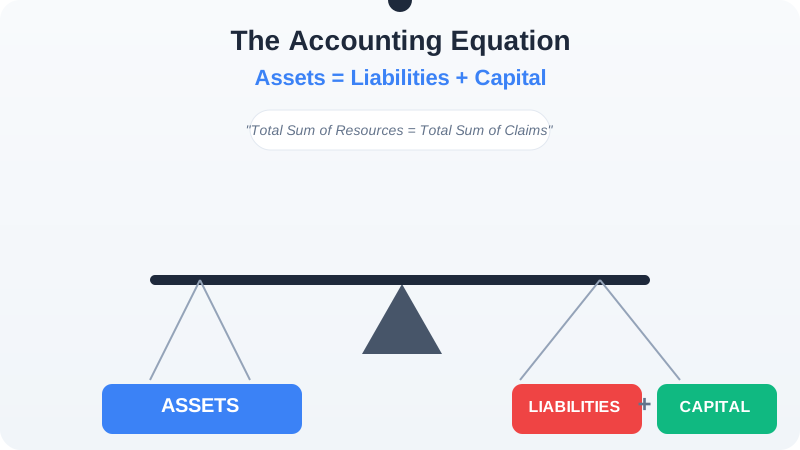
This is the very foundation of double-entry bookkeeping! The dual concept simply states: "for every debit, there is a credit". Every transaction has a two-sided effect to the extent of the exact same amount. This concept results in the fundamental accounting equation, which states that at any point in time, the assets of any entity must equal the total of owner's equity and outsider's liabilities:
Where:
• A stands for assets of the business
• L stands for liabilities (outsiders' claims) of the business
• C stands for proprietor's claim (capital) of the business
-
Revenue Recognition (Realisation) Concept
This concept emphasizes that profit should be considered only when realized. The big question is: at what stage is profit deemed accrued? When receiving the order? When executing it? When receiving cash? Accounting conforms with the law (Sales of Goods Act) and recognizes that revenue is earned only when the goods are transferred to the buyer. -
Matching Concept
Though a business is a continuous affair, its continuity is artificially split into several accounting years to determine periodic results. To accurately measure economic performance (profit), it becomes necessary to bring together all revenues and expenses relating to that specific period. The matching concept requires that the expenses incurred during a period must be matched against the revenues earned during that exact same accounting period.
2.1.3. Accounting Conventions
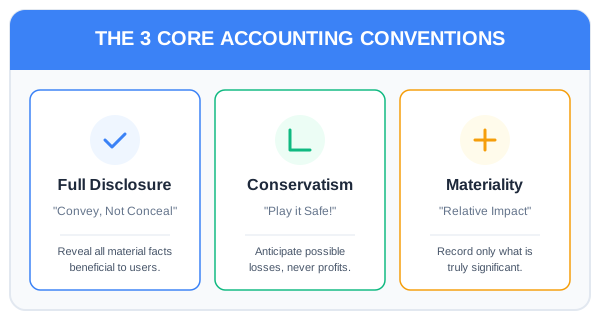
The term convention means an 'established usage'. Conventions are based on customs and practicability, often with some logic behind their usage.
-
Full Disclosure
The doctrine of disclosure suggests that financial statements should act as a means of conveying, not concealing. They must disclose all material, relevant, and reliable information that could benefit stakeholders. If material information doesn't fit in the balance sheet, it is often added as an "appending note." -
Conservatism or Prudence
Business is prone to risks and uncertainties. Prudence requires accountants to "anticipate no profits, but provide for all losses"—in other words, play it safe!
• Example: If the market price of stock is higher than its cost, it is recorded at cost. But if the market price is lower than the cost, it is recorded at market price to provide for that unforeseen loss. -
Materiality
This refers to the relative importance of an item or event. Decision-makers must constantly judge: "Is this item large enough for users of the information to be influenced by it?" According to the AAA, an item is material if knowledge of it would influence the decision of informed investors. -
Objectivity
Every accounting transaction must be recorded based on solid documentary evidence (invoices, bills, cash memos). This implies verifiability and ensures the information is reported accurately, free from the personal bias or judgment of those providing it.
Distinction between Concept and Convention
| Concept | Convention |
|---|---|
| An abstract idea which helps in developing a set of principles. | It generally denotes a rule of practice accepted over time. |
| It is regarded as the framework within which events and transactions are observed. | It states various principles as an accepted method of doing things. |
| It is not based on accounting conventions. | It is based on accounting concepts. |
| It is free from individual bias. | It is not entirely free from bias. |
2.2 Accounting Standards
Historically, similar organizations gave different treatments to similar transactions, leading to diverse and less meaningful accounting information. A need was felt for universal guidelines.
An accounting standard is a selected set of accounting policies or broad guidelines issued by an accounting body. They are the norms that guide the treatment of transactions and events, ensuring uniformity, comparability, and qualitative improvement in financial statements.
An accounting standard acts as a:
• Guide: Providing the basis through which accounts are prepared.
• Dictator: Giving the accountant no option but to follow it.
• Service Provider: Offering structured methods for complex issues.
• Harmoniser: Bringing uniformity to the adoption of accounting methods.
2.3 Objective of Accounting Standards
Why do we need them?
• To have uniformity in accounting methods.
• To become a reliable basis for audit work.
• To simplify complex accounting information.
2.5 Transaction
Any exchange of goods or services for cash or on credit by the business with any other business or customer is called a transaction.
"Any happening which brings change in the pattern of assets or liabilities or proprietorship of a business concern is a financial transaction to it." — Noble and Niwonger
Essential Features of a Transaction
- It is an economic activity: For example, purchasing goods or receiving cash.
- It results in a flow of value: Inflow or outflow of goods, services, or cash.
- It involves parties: External transactions involve two distinct parties.
- It can be qualitative or quantitative: Purchase is quantitative; depreciation is qualitative.
- It must be financial in nature: Non-monetary losses (like death of an efficient employee) are not financial transactions.
Classification of Transactions
(a) Based on Mode of Payment
- Cash Transaction: e.g., purchase of goods for cash.
- Credit Transaction: e.g., purchase of goods on credit.
(b) Based on Entity Involved - External Transaction: e.g., sale of goods to customers.
- Internal Transaction: e.g., depreciation on machinery.
(c) Based on Exchange - Exchange Transactions: Simultaneous purchase and sale.
- Non-Exchange Transactions: e.g., payment of income tax.
2.6 Events
Any happening which may or may not exert financial implication is regarded as an event.
Two main types of events: internal and external.
Important Note: All monetary events are regarded as transactions. So, all transactions are events, but all events are not transactions!
| Internal Event | External Event |
|---|---|
| • Use of raw material in production | • Technological improvement by competitor |
| • Strike of the union | • Change in price of goods |
| • Death of production manager | • External use of information |
Characteristics of Events
• It is regarded as an occurrence or happening.
• The occurrence may or may not be under the control of the business.
• It consists of a completed action or an expected future action.
• It may have a monetary or non-monetary expression.
Distinction between Transaction and Event
| Transaction | Event |
|---|---|
| 1. It is the consequence of exchange. | 1. It is a consequence of an occasion. |
| 2. It can be internal as well as external. | 2. It can be internal or external. |
| 3. It is an economic activity. | 3. It is a historical activity. |
| 4. It can involve more than one party. | 4. May involve internal or external parties/environment. |
| 5. It involves quantitative as well as qualitative changes. | 5. It involves only qualitative changes. |
| 6. All transactions are events. | 6. All events are not transactions. |
Rules for Determining Cash vs. Credit Transactions
If a problem or description does not specify:
- Treat as a Cash Transaction: If the description does not give the name of the party.
- Treat as a Credit Transaction: If the description does give the name of the party.
Examples: Which Events are Business Transactions?
| Events Treated as Business Transactions | Events NOT Treated as Business Transactions |
|---|---|
| 1. Purchase of goods for cash or on credit. | 1. Appointment and dismissal of an employee. |
| 2. Sale of goods for cash or on credit. | 2. Receiving a price-list from a supplier. |
| 3. Return of goods to a supplier. | 3. Placing an order with a supplier. |
| 4. Return of goods by a customer. | 4. Applied for an export licence. |
| 5. Purchase of a business property. | 5. Applied to the bank for a loan. |
| 6. Sale of a business property. | 6. Sending a price list to a customer. |
| 7. Cash/items introduced by proprietor as capital. | 7. Receiving an order from a customer. |
| 8. Cash/goods withdrawn for personal use. | 8. Sale of personal assets (personal bank account). |
| 9. Payment made to a supplier. | 9. Personal expenses paid out of personal funds. |
| 10. Payment received from a customer. | 10. Sending an appreciation letter. |
| 11. Discount allowed by supplier. | 11. Sudden death of an employee. |
Examples: Cash vs. Credit Transactions
| Examples of Cash Transactions | Examples of Credit Transactions |
|---|---|
| 1. Cash brought in as capital. | 1. Purchase of goods, payment later. |
| 2. Cash withdrawn for personal use. | 2. Sale of goods, payment later. |
| 3. Purchase of goods for cash/cheque. | 3. Purchase of assets, payment later. |
| 4. Sale of goods for cash/cheque. | 4. Sale of assets, payment later. |
| 5. Purchase or sale of machinery (cash). | 5. Expenses due but not yet paid. |
| 6. Borrowed cash from bank. | 6. Income earned but not yet received. |
Paper Transactions
Internal transactions otherwise called paper transactions. Examples include:
• Goods lost by theft, fire, or accident.
• Bad debts written off.
• Discount allowed to debtors.
• Discount received from supplier.
• Depreciation charged on a building.
2.7 Accounting Terminology (Basic Terms)
Detailed Terminology Index
- Proprietor/Owner
- Capital
- Drawings
- Business Transaction
- Debtor
- Creditor
- Accounts Receivables
- Accounts Payables
- Debit and Credit
- Goods
- Purchases
- Sales
- Purchases Return
- Sales Return
- Stock
- Assets
- Equity
- Liabilities
- Expense/Cost
- Expenditure
- Loss
- Profit
- Revenue
- Income
- Gain
- Discount
- Account
- Operating Cycle
- Cash Memo
- Invoice
- Receipt
- Voucher
- Discount
- Books of Accounts
- Proprietor
- Bad Debts
In every discipline, there are certain basic terms commonly used to understand a particular subjec### 1. Proprietor/Owner
The person who takes the initiative to start the business, invests their money (or money's worth), and bears the risk of the business is called the proprietor.
2. Capital
It is the value of items invested by the proprietor into the business. It may be in cash or in kind. Capital increases with the amount of profits and decreases with the amount of losses and drawings.
It can also be calculated by deducting the outside liabilities from the total assets:
Equation:
3. Drawings
It is the amount or benefit withdrawn by the owner from the business for personal or domestic use. It may be in the form of cash, goods, or assets.
4. Business Transaction
Any exchange of goods or services for cash or on credit by the business with any other person is a business transaction. A transaction is an economic activity of the business that changes its financial position.
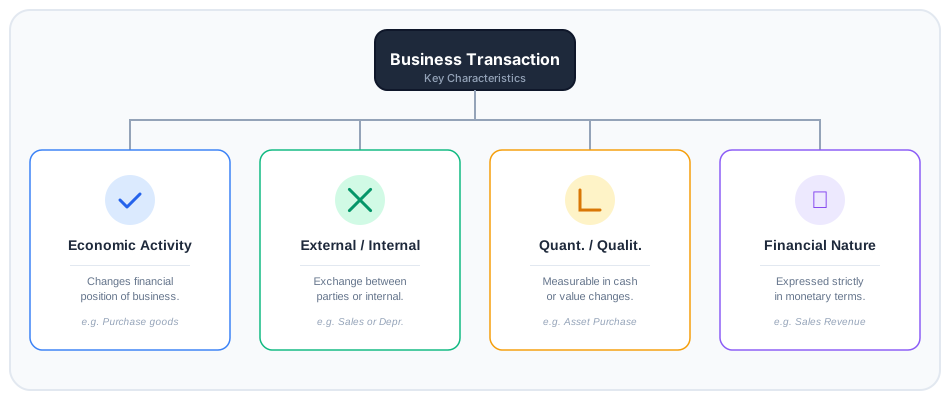
Features of a business transaction are:
- Economic activity: e.g., purchase of goods; receiving cash or cheque from debtors, etc., whereas inviting a friend to dinner is a social activity, not an economic one.
- External or internal: External transactions involve the exchange or transfer of values between two parties, whereas an internal transaction like the depreciation of an asset does not involve two parties.
- Quantitative or qualitative: Purchase of goods or assets for cash is a quantitative change, whereas the depreciation of an asset is a qualitative change.
- Financial in nature: The death of a debtor and consequent loss due to non-recovery of debt is a financial change (and hence a business transaction), but the death of an efficient employee is a non-monetary loss, and thus, not a financial transaction.
📝 Practice Lab: ILLUSTRATION 1
Question: State whether the following are business transactions?
(a) Somnath started a business with ₹ 3,0,000.
(b) Purchased equipment for cash ₹ 15,000.
(c) Appointed Mamata as manager on a monthly salary of ₹ 12,000.
(d) Paid for stationery ₹ 1,400.
(e) Placed an order with Subodh for the purchase of goods ₹ 70,000.
(f) Goods purchased for cash ₹ 18,000.
(g) Received price list from Naveen.
(h) Future profit estimated ₹ 25,000.
(i) Rent paid to landlord ₹ 9,000.
SOLUTION:
- (a) Yes, it is a business transaction because cash is being invested in the business.
- (b) Yes, it is a business transaction because an asset is purchased for the business.
- (c) No, it is not a business transaction because the mere appointment of a manager involves no exchange or movement of money at present. (However, when her salary becomes due or is paid, it will be treated as a business transaction).
- (d) Yes, it is a business transaction.
- (e) No, it is not a business transaction. merely placing an order does not change financial position. (However, when the goods are received in the future, it will be treated as a business transaction).
- (f) Yes, it is a business transaction.
- (g) No, it is not a business transaction.
- (h) No, it is not a business transaction as the profit is not yet earned.
- (i) Yes, it is a business transaction.
Core Accounting Entities & Concepts
5. Debtor
The person from whom amounts are due for goods sold or services rendered (or in respect of contractual obligations) is called a debtor. Debtors are collectively called 'Sundry Debtors' or 'Total Debtors'. The total amount due from sundry debtors is called 'Book Debts'.
6. Creditor
The person to whom an amount is owed by the enterprise on account of goods purchased or services availed is called a creditor. Creditors are collectively called 'Sundry Creditors', 'Total Creditors', or 'Trade Creditors'.
7. Accounts Receivables
This means the amount which outsiders owe to the business on revenue accounts. When goods are sold on credit to customers, they may accept bills drawn by the seller (creditor). These bills of exchange for a creditor are known as Bills Receivable (realisable within a year and part of current assets). The total of debtors and bills receivable is known as 'Accounts Receivables'.
8. Accounts Payables
This means the amount which the business owes to outsiders on revenue accounts. When goods are purchased on credit from suppliers, the customer may accept bills drawn by the seller. These bills of exchange for a customer are known as Bills Payable (payable within a year and part of current liabilities). The total of creditors and bills payable is known as 'Accounts Payable'.
9. Debit and Credit
The left-hand side of any account is arbitrarily called the debit side, and the right-hand side is called the credit side. The words debit and credit have no other meaning in accounting! Debit is abbreviated as Dr. and Credit as Cr. (taken from the first and last letters of these Latin words). Note: In accounting, debit and credit do not mean debtor and creditor.
10. Goods
This implies all those articles which have been purchased by the enterprise for sale in the usual course of business. It also includes raw material purchased for further processing.
- Example: Furniture purchased is considered "goods" for a furniture dealer, and cars purchased are "goods" for a car dealer. But if a cloth merchant or a fan manufacturer buys furniture or cars, those items are considered "assets" because they are not meant for resale in the ordinary course of their business.
11. Purchases
The purchase of raw materials for production or the purchase of finished goods for sale is called "purchases". The term 'purchase' is strictly used for the purchase of goods and not for the purchase of assets. (When an asset is purchased, an asset account is opened).
12. Sales
For the sale of finished goods, the term 'sales' is used. It may be cash sales or credit sales. When an asset is sold, the asset account is credited and not the sales account. When goods are sold at a discount, sales is credited with the net amount (i.e., after deducting the trade discount).
13. Purchases Return or Returns Outward
This is the part of the purchased goods that is returned to the seller. The reason for the return may be the supply of defective goods, goods not matching specifications, or any other valid reason.
- How it's used: To calculate the net purchases of a business, purchase returns are deducted from total purchases.
- Why the alternate name? It is also known as 'Returns Outward' because the goods are physically going out from the business back to the suppliers.
14. Sales Return or Returns Inward
This is the part of the sold goods which is returned by the customer to the business. The reason for the return may be an excessive supply, unspecified goods, or the supply of defective goods.
- How it's used: To calculate the net sales of the business, sales returns are deducted from total sales.
- Why the alternate name? It is also known as 'Returns Inward' because the goods are coming back into the business from the customers.
15. Stock
The goods left unsold at the end of the accounting period are called closing stock. The stock may be in the form of raw materials, work-in-progress, or finished goods.
- Crucial Rule: The closing stock of one accounting period automatically becomes the opening stock of the next accounting period!
The Big Three: Assets, Equity, and Liabilities
16. Assets
An asset is any owned physical object (tangible) or right (intangible) that holds a monetary value. In other words, assets are economic resources owned by a business from which future economic benefits are expected to flow to the enterprise.
"Assets are economic resources which are owned by a business and expected to benefit further operations." — W.B. Meigs and R.F. Meigs
"An asset is any physical object (tangible) or right (intangible) having a money value..." — Eric L. Kohler
"Assets are things of value to be included in its balance sheet, the business must have acquired the right to use or control the asset for the benefit of business." — Finnery and Miller
Examples of Assets: Cash, Debtors, Investments, Stock of goods, Plant and Machinery, Land & Building, Computers, Vehicles, and Goodwill.
These items hold value for the business for several different reasons:
- Cash has value because other things can be acquired with it.
- Debtors and Investments are assets because the business is entitled to claim cash from debtors in the future, and investments can be sold in the market for cash.
- Buildings, Plant & Machinery, and Goodwill are assets because they offer potential benefits, rights, or services. A building provides a place to conduct activities, while machinery helps manufacture goods.
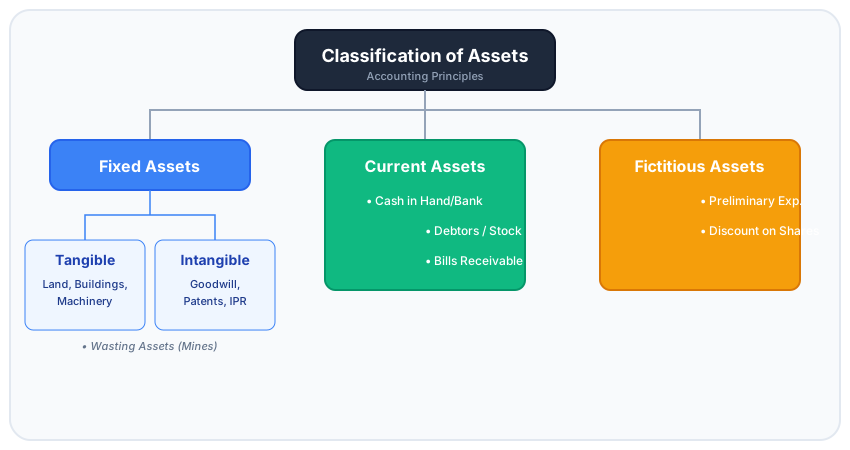
Classification of Assets
Assets can be broadly classified into three main categories:
A. Fixed Assets
These are assets purchased by the enterprise for long-term use, not for resale in the ordinary course of business. Their benefits are derived over a long period. Fixed assets are further classified as:
- Tangible Fixed Assets: Assets that can be touched and seen. This includes movable assets (vehicles, equipment, machinery), immovable assets (land and building), and wasting assets (mines, oil wells).
- Intangible Fixed Assets: Assets that cannot be touched or seen. These are usually rights to use, produce, or provide goods and services. Examples include goodwill, patent rights, copyrights, trademarks, and franchises.
B. Current Assets
Current assets are short-term assets held:
- In the form of cash.
- For conversion into cash as early as possible (usually within one year).
- For consumption in the production of goods.
- Examples: Cash in hand, Cash at bank, Stock of finished goods, Debtors, Bills Receivable, Stock of raw materials.
C. Fictitious Assets
These are assets that do not have any physical form and have no realisable value (they cannot be converted into cash). They are shown as assets purely because they are non-recurring payments.
- Examples: Expenses incurred before the formation of a company (preliminary expenses), expenses on the issue of shares or debentures, discount on shares/debentures, underwriting commission, etc.
17. Equity
In a broader sense, the term equity refers to all claims or rights against the assets of the enterprise. For every single asset of the business, someone has paid for it, or an amount is payable to someone for it. The amount payable to such persons is called equity.
It is divided into two distinct categories:
- Owner's Equity: The proprietor's claim (also called Capital).
- Outsider's Equity: The outsiders' or creditors' claims (also called Liabilities).
This creates the fundamental accounting equation:
Equation:
(More commonly written as: )
18. Liabilities
This refers to an amount owing by one person (a debtor) to another (a creditor), payable in money, goods, or services. In general, liabilities are financial obligations to outside parties arising from events that have already happened.
"An amount owing by one person (a debtor) to another (a creditor), payable in money, or in goods or services." — Eric L. Kohler
"In general, liabilities are obligations to outside parties arising from events that have already happened." — R.N. Anthony & J.S. Reece
Thus, a liability is an amount that arises as a result of purchasing goods or services from others on credit, or through cash borrowings used to finance the business.
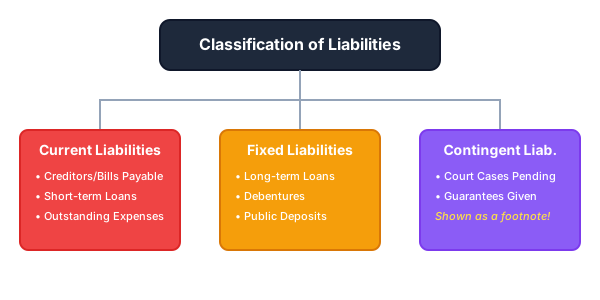
Classification of Liability
Liabilities may be broadly classified as follows:
A. Current Liabilities
These are liabilities which fall due for payment in a relatively short period (normally, within one year). These are also known as 'short-term liabilities'.
- Examples: Creditors, bills payable, short-term bank loans, outstanding expenses, etc.
B. Fixed Liabilities
This refers to long-term liabilities which are payable after a period of more than one year. These are also known as 'long-term liabilities'.
- Examples: Long-term bank loans, public deposits, debentures, etc.
C. Contingent Liabilities
These refer to amounts which may or may not become payable in the future. Future events will decide whether it is really a liability or not. Due to their uncertainty, these are known as contingent liabilities.
- Examples: Financial cases pending against the business in a court of law, or guarantees undertaken on behalf of others.
- Important Note: The expected value of contingent liabilities is either shown as a footnote (i.e., outside the balance sheet) or in the inner column only on the liability side. The accounting convention of 'full disclosure' requires this liability to be treated this way so investors aren't caught off guard!
📝 Practice Lab: ILLUSTRATION 2
Question: Identify the assets and liabilities from the following:
Plant & machinery; Goodwill; Salary due; Loan taken from Bank; Creditors (Amount payable to suppliers); Loan given to a friend; Debtors (Amount receivable from customers); Cash in hand; Unsold stock; Bank overdraft; Rent due to landlord; Computer; Fax machine.
SOLUTION:
- Plant & Machinery ➔ Asset
- Goodwill ➔ Asset
- Salary due ➔ Liability
- Loan taken from bank ➔ Liability
- Creditors ➔ Liability
- Loan given to a friend ➔ Asset (Because you have the right to receive this money back!)
- Debtors ➔ Asset
- Cash in hand ➔ Asset
- Unsold stock ➔ Asset
- Bank overdraft ➔ Liability
- Rent due to landlord ➔ Liability
- Computer ➔ Asset
- Fax Machine ➔ Asset
Understanding Costs, Expenses, and Expenditures
19. Expense/Cost
Expense is that portion of the expenditure which has been consumed during the current accounting period to earn revenue. Since expenses are the cost of goods and services consumed, these are also called expired costs.
- Examples: Salaries paid, postage, advertisement, depreciation on assets.
20. Expenditure
Expenditure is the actual amount incurred for recurring or non-recurring business transactions. Any payment made for the receipt of a benefit is called an expenditure. It may be classified into three distinct categories:
- (i) Revenue Expenditure: The amount incurred for the purchase of goods or services which are consumed during the current period. This is the amount incurred for meeting day-to-day expenses of a recurring nature (like salaries, rent, insurance, carriage, freight, etc.).
- (ii) Capital Expenditure: The payment made for the purchase of assets from which the benefit will be derived in the future. It is a non-recurring payment that increases the earning capacity of the business (like buying land, building, machinery, computers, etc.).
"Capital Expenditure may be described as outlay resulting in the increases or acquisition of asset or increase in the earning capacity of a business." — William Pickles
- (iii) Deferred Revenue Expenditure: A massive expenditure of a revenue nature where the effect of generating income spreads over a number of years. It is temporarily capitalised and spread equally over the years the benefit is anticipated. (For instance, a heavy expenditure on an advertisement campaign for launching a new product. This might be deferred over the next four or five years instead of taking the massive hit in year one).
Business Outcomes: Profit, Loss, Income, and Gains
21. Loss
Loss is an unwanted burden on the business which does not generate any revenue. It always decreases owner's equity. It can be classified as:
- Normal Loss: Arises due to the inherent nature of the product (e.g., evaporation, leakage, shrinkage, loss of weight).
- Abnormal Loss: The result of some mishappening (e.g., fire, theft, earthquake, flood, storm).
(Note: The excess of total expenses over total revenues is also simply termed as a loss).
22. Profit
The excess of total revenues over total expenses of an accounting period. Profit always increases the owner's equity.
23. Revenue
This is the flow of benefits to the business generated out of resources controlled by it. It always adds to the capital and assets of the business.
- In trading/manufacturing, it results from the sale of goods.
- For professionals (accountants, lawyers, doctors), revenue is generated via fees.
- It can also be earned via interest on investments, dividends on shares, or royalties.
24. Income
The excess of revenue over expenses is called Income.
- Example: If goods costing ₹ 50,000 are sold for ₹ 70,000.
- The sale proceeds (₹ 70,000) = Revenue
- The cost of goods sold (₹ 50,000) = Expense
- The revenue minus cost (₹ 20,000) = Income
Equation:
25. Gain
It is a profit of an irregular nature, such as the profit on the sale of a fixed asset. The gain may be classified as short-term or long-term depending upon the period for which the asset was held in the business.
26. Discount
The reduction in the price or in the payment of goods allowed by a business enterprise to its customers is called a discount. It is classified as:
- (i) Trade Discount: The reduction in the list/catalogue price allowed by a seller to a customer. It is deducted directly in the invoice or cash memo from the gross sale proceeds. Crucial Rule: Trade discount is not recorded in the books of the buyer or seller! The transaction is recorded strictly with the net sale proceeds (Gross sale proceeds less trade discount).
- (ii) Cash Discount: The reduction allowed by a creditor to his debtor for making a prompt or quick payment of the amount due. Unlike trade discounts, cash discounts are recorded in the books of both the creditor and the debtor. It is an expense for the creditor (who receives less cash) and an income for the debtor (who pays less cash).
27. Account
An account is a date-wise summary of transactions relating to persons, property, expenses, and incomes. It has two sides. The left-hand side of the account is called the debit side, and the right-hand side is called the credit side. Transactions of a similar nature are recorded at one place, which is called an 'account'.
An 'account' is abbreviated as A/c. This abbreviation may be used anywhere except at the very top title of the account.
Here is the standard format, using a Building Account as an example:
BUILDING ACCOUNT
(Dr.) (Cr.)
| Date | Particulars | J.F. | Amount (₹) | Date | Particulars | J.F. | Amount (₹) |
|---|---|---|---|---|---|---|---|
Classification of Accounts
Accounts can be broadly classified into two main categories: Personal Accounts and Impersonal Accounts.
(A) Personal Accounts
The accounts of the persons with whom various transactions are entered into (such as credit sales, credit purchases, sales returns, purchases returns, cash or cheques received and issued) are known as personal accounts.
Personal accounts are further classified as:
- (i) Natural personal accounts: The accounts of persons made of flesh and bones (i.e., human beings). Examples: Malika’s Account, Abhisek’s Account, Khushwant’s Account, etc.
- (ii) Artificial personal accounts: These persons are not made of flesh and bones but are treated as persons in the eyes of the law. They can sue and be sued for their omissions and commissions. Examples: Companies, banks, co-operative societies, trusts, etc.
- (iii) Representative personal accounts: The accounts prepared to represent natural or artificial persons. These are prepared for the convenience of recording transactions. One particular account may represent hundreds or thousands of persons!
- Examples: Expense outstanding, expense prepaid, income accrued (due but not received), income received in advance. A "Salary Due Account" will represent the total salary amount still payable to all staff members.
(B) Impersonal Accounts
Accounts which do not relate to persons are called impersonal accounts. They are further classified as:
- (i) Real Accounts: The accounts relating to the property of the business.
- (a) Tangible real accounts: Accounts of properties which can be touched and seen. Examples: Land, building, plant, furniture, vehicles, cash, etc.
- (b) Intangible real accounts: Accounts of properties which cannot be touched or seen but can be felt or used as a right. Examples: Goodwill (reputation of the business), Patent right (right of invention), Copyright (right of publications or music compositions), etc.
- (ii) Nominal Accounts: The accounts of expenses, losses, incomes, or gains are known as nominal accounts. Examples: Rent account, loss by theft account, interest received account, profit on sale of machinery account, etc.
Key Accounting Documents & Concepts
28. Operating Cycle
The operating cycle denotes the time between the acquisition of assets for processing and their realization into cash. Generally, an operating cycle consists of a period of 12 months.
29. Cash Memo
A cash memo is a document in which transactions relating to cash sales or cash purchases are recorded. A cash memo is received at the time of a cash purchase and it is given to the customer at the time of a cash sale.
30. Invoice
An invoice is a document which records credit transactions relating to the sale or purchase of goods and commodities. A sales invoice is prepared at the time of a credit sale.
31. Receipt
Evidence of payment on any transaction is termed as a receipt. It serves as direct proof of giving cash.
32. Voucher
A voucher denotes a document prepared for the purpose of recording business transactions. There are different types of vouchers:
- Transaction Voucher: A voucher which shows exactly one debit and one credit.
- Debit Voucher: A voucher which contains multiple debits and one credit.
- Credit Voucher: A voucher which contains multiple credits and one debit.
- Complex/Journal Voucher: A voucher which contains multiple debits and multiple credits.
33. Discount
A type of concession in payment intended to increase sales or get payment earlier is known as a discount. There are two types:
- Cash discount: A type of discount given for ensuring prompt payment.
- Trade discount: A type of discount on the marked price allowed with the objective of increased sales.
34. Books of Accounts
The physical or digital books in which business transactions are recorded are called books of accounts. These may be in the form of a journal, ledger, purchase book, sales book, or cash book.
35. Proprietor
A person who owns the business and contributes capital for the purpose of earning a profit.
36. Bad Debts
The amount which a debtor fails to pay and for which there is no hope of repayment is termed as a bad debt. Bad debts usually arise on account of death, insolvency, or the complete collapse of the financial position of the debtor.