
Navigation
Chapter 5: Ledger
[!IMPORTANT]
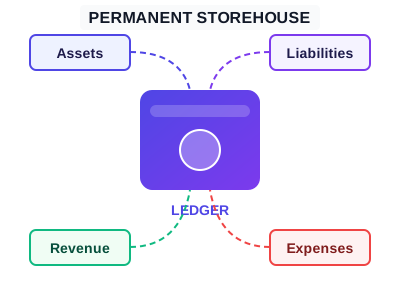
Key Takeaway: A permanent storehouse of all transactions which supplies consolidated information of each account for a given period.
5.0 Introduction and Meaning
The Ledger is a principal or primary book of accounts. It is the most important book in the accounting system. It contains all the accounts (assets, liabilities, capital, revenue, and expenses) to which the transactions recorded in the books of original entry are transferred (posted).
The Ledger is the ultimate destination of all transactions. It is also called the book of "final entry". In the ledger, the information is classified by nature and relevance. It may be maintained as a bound book, loose-leaf sheets, or (in the case of computerized accounting) on digital storage.
It may be concluded that the ledger is a principal book which provides consolidated information of each account for a given period of time at one place.
Definitions from the Experts
"Ledger is a book of accounts which contains in a suitably classified form, the final and permanent record of trader's transactions." — V.G. Vickery
"A ledger is the most important book of accounts and is the (final) destination of the entries made in the subsidiary books." — William Pickles
"Ledger is the permanent storehouse of all the transactions." — Fieldhouse Arther
"Ledger epitomises the general operation of principles of book-keeping." — L.C. Cropper
5.1 Features of Ledger
The main features of a ledger may be stated as follows:
- Principal or primary book: It is the foundation of the accounting system.
- Classification: Transactions are classified under appropriate heads, called accounts.
- Condensation: These accounts contain the condensed and summarised record of all the related transactions.
- Status insight: The information contained in the ledger account can be used to draw a conclusion regarding the status of an account.
- Final Accounts Basis: It is the basis of preparing the final accounts (Trading, P&L, Balance Sheet).
5.2 Necessity and Steps Involved in Ledger
Book-keeping must enable us to find out readily:
• How much is due to us by every customer?
• How much is payable by us to each of our suppliers?
• How much has been spent on a particular head of expenditure?
• How much has been earned from a particular source of income?
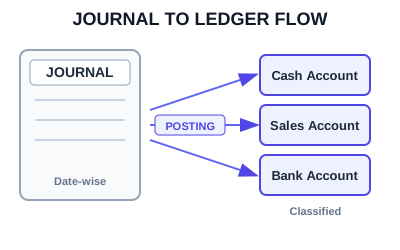
Such information cannot be made available by the Journal alone because transactions are recorded chronologically, meaning heterogeneous (mixed) transactions take place every single day. The Ledger groups all transactions over a period relating to one account at one place.
The Process of Posting
- Identify transactions relating to one account from the journal in chronological order.
- Record identified transactions at one place called an account.
- Divide each account into two parts: Left (Debit) and Right (Credit).
- Total the two sides and find the difference (known as the balance).
5.3 Difference Between Journal and Ledger
| Basis of Difference | Journal | Ledger |
|---|---|---|
| 1. Stage of entry | Book of prime entry. | Book of final entry. |
| 2. Timing | Recorded as soon as transaction originates. | Posted after recording in journal. |
| 3. Order | Chronological (Date-wise). | Analytical (Nature-wise/Classified). |
| 4. Narration | Written for each entry. | Not required. |
| 5. Folio | Ledger folio (L.F.) is written. | Journal folio (J.F.) is written. |
| 6. Final accounts | Cannot be prepared directly. | Absolute basis of preparing final accounts. |
| 7. Columns vs Sides | Two amount columns (Dr/Cr). | Two sides (Left = Dr, Right = Cr). |
| 8. Balancing | Not balanced, only page totals. | Every account is balanced. |
5.4 Inter-Relationship Between Journal and Ledger
The journal and ledger are both important, but they serve different goals:
• Sequence: Journaling is the first step; Posting is the next.
• Order: Journal = Chronological; Ledger = Analytical.
• Source: Journal uses vouchers (documentary evidence); Ledger uses the journal.
• Object: Journal establishes identity; Ledger provides condensed information.
5.5 Classification of Ledger
Ledgers can be classified on several bases:
- Alphabetical order: Based on the account name.
- Nature of accounts: Permanent accounts (Real/Personal) and Temporary accounts (Nominal).
- Common Classification (Division of Labour):
- (a) Debtors Ledger (Sales Ledger): Accounts of customers.
- (b) Creditors Ledger (Bought Ledger): Accounts of suppliers.
- (c) General Ledger: All other assets, liabilities, capital, revenue, and expenses.
5.6 Advantages of Ledger
- Quickly ascertains book value of various assets.
- Shows total debtors and creditors directly.
- Provides aggregated data for total purchases and sales.
- Detailed breakdown of expenses and incomes.
- Check arithmetical accuracy via Trial Balance.
- Helps in preparing Financial Statements (Trading A/c, P&L, Balance Sheet).
5.7 Proforma of Ledger Account (Traditional T-Shape)
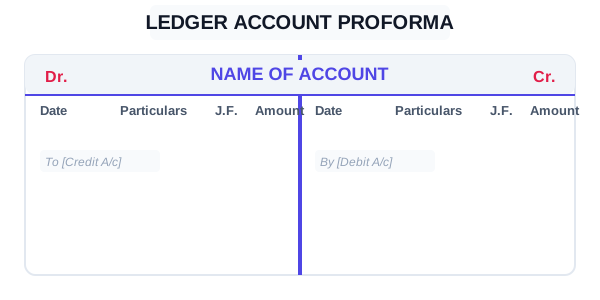
Name of Account
| Dr. | Cr. | |||||||
|---|---|---|---|---|---|---|---|---|
| Date | Particulars | J.F. | Amount (₹) | Date | Particulars | J.F. | Amount (₹) | |
| To Name of Credit A/c | By Name of Debit A/c |
5.8 Posting Procedure
Posting means the physical process of transferring transactions from books of original entry to the ledger.
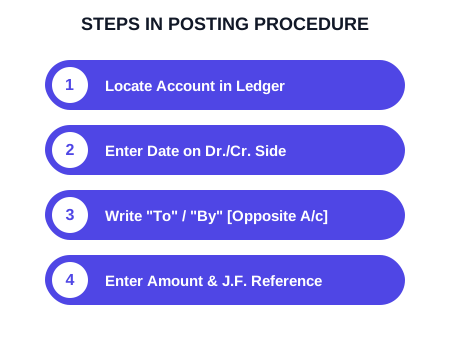
Procedure for Posting a "Debit Account":
- Open the page on which the account appears.
- Enter the date on the Debit side.
- Record the name of the Credit account as "To [Account Name]".
- Enter the J.F. reference and the amount.
Procedure for Posting a "Credit Account":
- Open the page on which the account appears.
- Enter the date on the Credit side.
- Record the name of the Debit account as "By [Account Name]".
- Enter the J.F. reference and the amount.
5.10 Posting of Compound Entry
Compound entry means one combined entry for different transactions of similar nature on the same date. Posting follows the same logic, ensuring the total debit matches the total credit across multiple accounts.
📝 Practice Lab: ILLUSTRATION 1
Question: On 1st July 2015, machinery was purchased for ₹ 10,000 in cash from Bhim. Give the journal entry and prepare the ledger accounts.
Solution
Journal Entry
| Date | Particulars | L.F. | Debit (₹) | Credit (₹) |
|---|---|---|---|---|
| 2015 July 1 | Machinery A/c ... Dr. To Cash A/c (Being machinery purchased for cash) | 10,000 | 10,000 |
Ledger Accounts
Machinery Account
| Dr. | Cr. | |||||||
|---|---|---|---|---|---|---|---|---|
| Date | Particulars | J.F. | Amount | Date | Particulars | J.F. | Amount | |
| 2015 July 1 | To Cash A/c | 10,000 |
Cash Account
| Dr. | Cr. | |||||||
|---|---|---|---|---|---|---|---|---|
| Date | Particulars | J.F. | Amount | Date | Particulars | J.F. | Amount | |
| 2015 July 1 | By Machinery A/c | 10,000 |
📝 Practice Lab: ILLUSTRATION 2 (Comprehensive Solution)
Question: Enter the following transactions in the journal and post them into ledger:
- Mar 1: Business commenced with cash ₹ 40,000 and equipments ₹ 8,000.
- Mar 4: Goods purchased from Vikrant: Cash ₹ 7,000 and Credit ₹ 5,000.
- Mar 5: Paid to Vikrant ₹ 4,900; Discount received ₹ 100.
Ledger Accounts
Cash Account
| Dr. | Cr. | |||||||
|---|---|---|---|---|---|---|---|---|
| Date | Particulars | J.F. | Amount (₹) | Date | Particulars | J.F. | Amount (₹) | |
| 2016 Mar. 1 | To Capital A/c. | 40,000 | 2016 Mar. 4 | By Purchase | 7,000 | |||
| Mar. 5 | By Vikrant | 4,900 |
Equipments Account
| Dr. | Cr. | |||||||
|---|---|---|---|---|---|---|---|---|
| Date | Particulars | J.F. | Amount (₹) | Date | Particulars | J.F. | Amount (₹) | |
| 2016 Mar. 1 | To Capital A/c. | 8,000 |
Capital Account
| Dr. | Cr. | |||||||
|---|---|---|---|---|---|---|---|---|
| Date | Particulars | J.F. | Amount (₹) | Date | Particulars | J.F. | Amount (₹) | |
| 2016 Mar. 1 Mar. 1 | By Cash A/c. By Equipments A/c. | 40,000 8,000 |
Purchases Account
| Dr. | Cr. | |||||||
|---|---|---|---|---|---|---|---|---|
| Date | Particulars | J.F. | Amount (₹) | Date | Particulars | J.F. | Amount (₹) | |
| 2016 Mar. 4 Mar. 4 | To Vikrant To Cash A/c. | 5,000 7,000 |
Vikrant's Account
| Dr. | Cr. | |||||||
|---|---|---|---|---|---|---|---|---|
| Date | Particulars | J.F. | Amount (₹) | Date | Particulars | J.F. | Amount (₹) | |
| 2016 Mar. 5 Mar. 5 | To Cash A/c. To Discount A/c. | 4,900 100 | 2016 Mar. 4 | By Purchase A/c. | 5,000 |
Discount Account
| Dr. | Cr. | |||||||
|---|---|---|---|---|---|---|---|---|
| Date | Particulars | J.F. | Amount (₹) | Date | Particulars | J.F. | Amount (₹) | |
| 2016 Mar. 5 | By Vikrant | 100 |
📝 Practice Lab: ILLUSTRATION 3
Question: Pass the entries in the books of Ramakant Rath and post them in the ledger:
2016
• Jan. 30: Received cash on account of sales ₹ 5,000; Interest ₹ 4,000; Commission ₹ 500.
• Jan. 31: Paid cash on account of purchases ₹ 3,000; Interest ₹ 2,000 and commission ₹ 1,000.
Solution
Books of Ramakant Rath
JOURNAL
| Date | Particulars | L.F. | Debit (₹) | Credit (₹) |
|---|---|---|---|---|
| 2016 Jan. 30 | Cash A/c. ... Dr. To Sales A/c. To Interest A/c. To Commission A/c. (Being receipt of cash on account of sales, interest and commission) | 9,500 | 5,000 4,000 500 | |
| Jan. 31 | Purchases A/c. ... Dr. Interest A/c. ... Dr. Commission A/c. ... Dr. To Cash A/c. (Being payment of cash on account of purchases, interest and commission) | 3,000 2,000 1,000 | 6,000 |
LEDGER
Cash Account
| Dr. | Cr. | |||||||
|---|---|---|---|---|---|---|---|---|
| Date | Particulars | J.F. | Amount (₹) | Date | Particulars | J.F. | Amount (₹) | |
| 2016 Jan. 30 Jan. 30 Jan. 30 | To Sales A/c. To Interest A/c. To Commission A/c. | 5,000 4,000 500 | 2016 Jan. 31 Jan. 31 Jan. 31 Jan. 31 | By Purchases A/c. By Interest A/c. By Commission A/c. By Balance c/d | 3,000 2,000 1,000 3,500 | |||
| Total | 9,500 | Total | 9,500 | |||||
| Feb. 1 | To Balance b/d | 3,500 |
Sales Account
| Dr. | Cr. | |||||||
|---|---|---|---|---|---|---|---|---|
| Date | Particulars | J.F. | Amount (₹) | Date | Particulars | J.F. | Amount (₹) | |
| 2016 Jan. 30 | By Cash A/c. | 5,000 5,000 |
Purchases Account
| Dr. | Cr. | |||||||
|---|---|---|---|---|---|---|---|---|
| Date | Particulars | J.F. | Amount (₹) | Date | Particulars | J.F. | Amount (₹) | |
| 2016 Jan. 31 | To Cash A/c. | 3,000 3,000 |
Interest Paid Account
| Dr. | Cr. | |||||||
|---|---|---|---|---|---|---|---|---|
| Date | Particulars | J.F. | Amount (₹) | Date | Particulars | J.F. | Amount (₹) | |
| 2016 Jan. 31 | To Cash A/c. | 2,000 2,000 |
Interest Received Account
| Dr. | Cr. | |||||||
|---|---|---|---|---|---|---|---|---|
| Date | Particulars | J.F. | Amount (₹) | Date | Particulars | J.F. | Amount (₹) | |
| 2016 Jan. 30 | By Cash A/c. | 4,000 4,000 |
Commission Paid Account
| Dr. | Cr. | |||||||
|---|---|---|---|---|---|---|---|---|
| Date | Particulars | J.F. | Amount (₹) | Date | Particulars | J.F. | Amount (₹) | |
| 2016 Jan. 31 | To Cash A/c. | 1,000 1,000 |
Commission Received Account
| Dr. | Cr. | |||||||
|---|---|---|---|---|---|---|---|---|
| Date | Particulars | J.F. | Amount (₹) | Date | Particulars | J.F. | Amount (₹) | |
| 2016 Jan. 30 | By Cash A/c. | 500 500 |
5.11 Posting of Opening Entry
Balances of assets, liabilities and capital related to the last year are brought forward to the next year by passing a journal entry called an opening entry. Posting of the opening journal entry is not done in the manner as explained earlier.
The balances are simply incorporated in the relevant ledger accounts on the debit and credit sides. The accounts which are debited in the journal entry will be shown in the concerned ledger accounts as 'To Balance b/d' (b/d means brought down). The accounts which are credited in the journal entry will be shown in the concerned ledger accounts as 'By Balance b/d'.
📝 Practice Lab: ILLUSTRATION 4 (Opening Entry)
Question: Dinesh Mehta was doing business as a general merchant. On January 1, 2016, his position was as follows:
• Cash in hand ₹ 2,500; Cash at bank ₹ 3,000; Stock ₹ 5,000; Plant account ₹ 9,000; Amount due from Harish ₹ 1,500.
• His liabilities were: Loan from Neena ₹ 4,000; Due to Gurpreet ₹ 2,000.
Give the opening entry and open the new set of books.
SOLUTION
BOOKS OF DINESH MEHTA
Journal
| Date | Particulars | L.F. | Debit (₹) | Credit (₹) |
|---|---|---|---|---|
| 2016 Jan. 1 | Cash Account ... Dr. Bank Account ... Dr. Stock Account ... Dr. Plant Account ... Dr. Harish ... Dr. To Neena's Loan Account To Gurpreet To Capital Account (Being opening entry in respect of above accounts, the balance being capital) | 2,500 3,000 5,000 9,000 1,500 | 4,000 2,000 15,000 |
💡 Note on Capital Calculation:
Capital = Assets - Liabilities
= (2,500 + 3,000 + 5,000 + 9,000 + 1,500) - (4,000 + 2,000)
= (21,000 - 6,000) = ₹ 15,000.
Ledger
Cash Account
| Dr. | Cr. | |||||||
|---|---|---|---|---|---|---|---|---|
| Date | Particulars | J.F. | Amount (₹) | Date | Particulars | J.F. | Amount (₹) | |
| 2016 Jan. 1 | To Balance b/d. | 2,500 |
Bank Account
| Dr. | Cr. | |||||||
|---|---|---|---|---|---|---|---|---|
| Date | Particulars | J.F. | Amount (₹) | Date | Particulars | J.F. | Amount (₹) | |
| 2016 Jan. 1 | To Balance b/d. | 3,000 |
Stock Account
| Dr. | Cr. | |||||||
|---|---|---|---|---|---|---|---|---|
| Date | Particulars | J.F. | Amount (₹) | Date | Particulars | J.F. | Amount (₹) | |
| 2016 Jan. 1 | To Balance b/d. | 5,000 |
Plant Account
| Dr. | Cr. | |||||||
|---|---|---|---|---|---|---|---|---|
| Date | Particulars | J.F. | Amount (₹) | Date | Particulars | J.F. | Amount (₹) | |
| 2016 Jan. 1 | To Balance b/d. | 9,000 |
Harish Account
| Dr. | Cr. | |||||||
|---|---|---|---|---|---|---|---|---|
| Date | Particulars | J.F. | Amount (₹) | Date | Particulars | J.F. | Amount (₹) | |
| 2016 Jan. 1 | To Balance b/d. | 1,500 |
Neena's Loan Account
| Dr. | Cr. | |||||||
|---|---|---|---|---|---|---|---|---|
| Date | Particulars | J.F. | Amount (₹) | Date | Particulars | J.F. | Amount (₹) | |
| 2016 Jan. 1 | By Balance b/d. | 4,000 |
Gurpreet
| Dr. | Cr. | |||||||
|---|---|---|---|---|---|---|---|---|
| Date | Particulars | J.F. | Amount (₹) | Date | Particulars | J.F. | Amount (₹) | |
| 2016 Jan. 1 | By Balance b/d. | 2,000 |
Capital Account
| Dr. | Cr. | |||||||
|---|---|---|---|---|---|---|---|---|
| Date | Particulars | J.F. | Amount (₹) | Date | Particulars | J.F. | Amount (₹) | |
| 2016 Jan. 1 | By Balance b/d. | 15,000 |
5.12 Balancing of Accounts
Balancing means to find out the difference between the two sides (i.e., debit and credit) of ledger accounts.
According to Eric L. Kohler, Balance is "the difference between the total debits and the total credits of an account or the total of an account containing only debits or credits".
Balancing is followed by the posting of business transactions. Balancing ascertains the net position of the ledger account. The difference between the total of the debit side and the credit side in an account is called the 'balance'. The balance may be ascertained weekly, fortnightly, monthly, quarterly, etc.
The following three situations may arise while balancing the accounts:
- Closed Account: When the total of the debit side and credit side of an account is equal. In this case, there will be no balance. Such an account is called a 'closed account'.
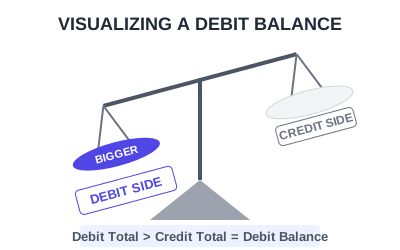
- Debit Balance: When the total of the debit side of an account is bigger than the total of the credit side, the excess of the debit side amount over the credit side is called a 'debit balance'. It should be remembered that all assets, expenses & losses and customer's accounts have debit balances.
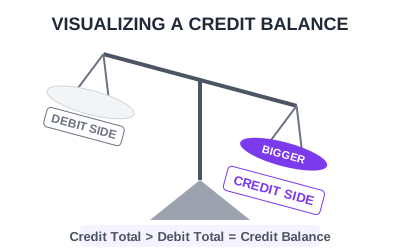
- Credit Balance: When the total of the credit side of an account is bigger than the total of the debit side, the excess of the credit side amount over the debit side is called a 'credit balance'. It is important to note that all liabilities, revenue and capital have credit balances. But, sometimes the capital account may show a debit balance.
Example of Balancing
Here is exactly how an account transforms during the balancing process:
Account before balancing:
ABHISEK ACCOUNT
| Dr. | Cr. | |||||||
|---|---|---|---|---|---|---|---|---|
| Date | Particulars | J.F. | Amount (₹) | Date | Particulars | J.F. | Amount (₹) | |
| 2016 Mar. 1 Mar. 18 Mar. 30 | To Sales A/c. To Sales A/c. To Sales A/c. | 35,000 25,000 20,000 | 2016 Mar. 4 Mar. 19 | By Cash A/c. By Bank A/c. | 18,000 24,000 |
Account after balancing:
(Notice how the ₹ 38,000 balance is added to the credit side to force the two columns to equal ₹ 80,000, and is then brought down to the debit side for the next month!)
ABHISEK ACCOUNT
| Dr. | Cr. | |||||||
|---|---|---|---|---|---|---|---|---|
| Date | Particulars | J.F. | Amount (₹) | Date | Particulars | J.F. | Amount (₹) | |
| 2016 Mar. 1 Mar. 18 Mar. 30 | To Sales A/c. To Sales A/c. To Sales A/c. | 35,000 25,000 20,000 | 2016 Mar. 4 Mar. 19 Mar. 31 | By Cash A/c. By Bank A/c. By Balance c/d. | 18,000 24,000 38,000 | |||
| Total | 80,000 | Total | 80,000 | |||||
| Apr. 1 | To Balance b/d. | 38,000 |
Advanced Journal Entries: Discounts and Bad Debts
6. Treatment of Trade Discount
Trade discount is an allowance or concession given by the seller to the buyer by way of reduction in the list price/catalogue price. It is allowed by the manufacturer to the wholesaler or by the wholesaler to the retailer or by the retailer to the customer. The trade discount may be allowed on bulk purchases or on an inducement to the buyer. These days, it is very popular to offer off season discount, which is a sale of goods at trade discount is recorded with net amount (i.e. list price-trade discount). Trade discount is not recorded in the books. Entry for the purchase or sale of goods at trade discount is recorded with net amount.
• (i) Sold goods to Raman of the list price ₹ 1,000, trade discount 10%.
- Raman A/c ......................................... Dr. 900
- To Sales A/c. ............................................... 900
7. Treatment of Cash Discount (Full Settlement)
In some cases, creditor may allow some concession to his debtor to prompt him to make the payment within the period of credit allowed. Such concession is known as 'cash discount'. It is allowed by the person receiving the payment and represents expenditure. It is availed by the person making the payment and represents income.
• (i) Received ₹ 1,000 from Triloki Nath in full settlement against the amount due from him ₹ 1,050.
- Cash A/c. ..................................... Dr. 1,000
- Discount allowed A/c. ............... Dr. 50
- To Triloki Nath ............................................ 1,050
• (ii) Paid ₹ 960 to Darbara Singh in full settlement against the amount due to him ₹ 1,000.
- Darbara Singh ........................... Dr. 1,000
- To Cash A/c. .............................................. 960
- To Discount received A/c. ........................ 40
8. Treatment of Bad Debts
Bad debt represents an irrecoverable amount from the customer. It is a loss to the business. Such a loss may arise due to the death, insolvency, dishonesty, etc. of the customer. Insolvency position arises when the liabilities of the customer exceed his assets. On the insolvency, there may be no recovery or partial recovery of debt. The amount recovered is debited to Cash Account and amount irrecoverable is debited to Bad Debts Account as it is a loss.
• Sarkar who owed us ₹ 1,000 is declared insolvent and 60 paise in a rupee is received as final dividend from his estate.
- Cash A/c. ..................................... Dr. 600
- Bad debts A/c. ........................... Dr. 400
- To Sarkar .................................................. 1,000
9. Treatment of Bad Debts Recovered
It is evident from the above entry that whenever irrecoverable amount is written off, the personal account is credited. If after some time, any payment is received against a debt previously written off then it represents income and as such should be credited to an account styled as 'bad debts recovered account'. Personal account must not be credited.
• Chandji remitted ₹ 400 against the amount previously written off as bad.
- Cash A/c. ..................................... Dr. 400
- To Bad debts recovered A/c. ................. 400
Mastering Ledger Balancing
[!NOTE]
Important Note: All the nominal accounts (i.e., accounts of expenses, losses, incomes and gains) are not balanced at the end of the accounting period because these are transferred to Trading and Profit & Loss Account. These are totalled on one side.
5.13 Necessity of Balancing an Account
The need for balancing an account arises due to following reasons:
- Instant Position: It helps to know, at a glance, the position of any account at any time.
- Trial Balance Basis: As the name indicates, the trial balance is a trial to check the arithmetical accuracy of the books of accounts from the balances of ledger accounts.
- Cash Judgment: The cash position of the business can be judged daily by balancing cash account.
- Periodical Results: The balances of nominal accounts are used for determining the periodical results by preparing a Trading and Profit & Loss Account.
- Debtors & Creditors: The balances of personal accounts help the traders to know the amount receivable from the customers and amount payable to the suppliers.
- Financial Position: The balances of real and personal accounts are used to prepare a balance sheet at the end of each accounting year.
5.14 Balancing Procedure (Step-by-Step)
The following steps are recommended while balancing an account:
- Take up the total of debit and credit sides on a rough sheet.
- Subtract the total of the lighter side from the total of bigger side. The difference is called the 'balance'.
- The 'balance' is put on the smaller side of the ledger account, as the last item.
- If the balance is written on the debit side, write 'To Balance c/d.' (c/d = carried down). In case of credit side, write 'By Balance c/d'.
- Total both the sides. Totals should be on equal level. Draw a single line above each total and a double line immediately beneath.
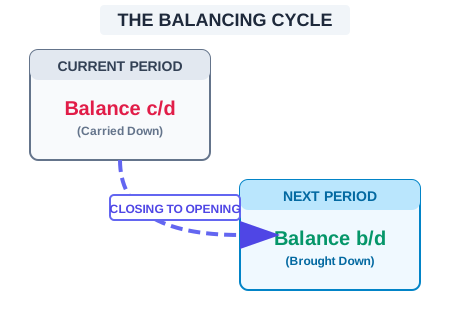
- Finally, the debit balance should be brought down to the debit side as 'To Balance b/d' (b/d = brought down). Credit balance as 'By Balance b/d' on the opposite side.
- Totals in the amount column on both sides must be shown horizontally.
📝 Practice Lab: ILLUSTRATION 5 (Ledger Account Prep)
Question: Pass Journal entries in the books of Protima Bedi and prepare Navdeep's account in the ledger.
2015
• June 1: Goods purchased from Navdeep on credit at 10% trade discount ₹ 18,000.
• June 5: Returned goods to Navdeep ₹ 750.
• June 8: Purchased goods on cash from Navdeep ₹ 3,000.
• June 9: Paid to Navdeep by cheque ₹ 1,075; Discount received ₹ 25.
• June 18: Purchased goods from Navdeep ₹ 7,000.
• June 25: Paid to Mehmood on behalf of Navdeep ₹ 5,000.
• June 30: Amount deposited directly in Navdeep's bank account ₹ 3,500.
SOLUTION:
BOOKS OF PROTIMA BEDI
Journal
| Date | Particulars | L.F. | Debit (₹) | Credit (₹) |
|---|---|---|---|---|
| 2015 June 1 | Purchases A/c. ... Dr. To Navdeep (Being goods purchased at 10% trade discount) | 16,200 | 16,200 | |
| June 5 | Navdeep ... Dr. To Purchases Return A/c. (Being goods returned to Navdeep) | 750 | 750 | |
| June 8 | Purchases A/c. ... Dr. To Cash A/c. (Being goods purchased for cash) | 3,000 | 3,000 | |
| June 9 | Navdeep ... Dr. To Bank A/c. To Discount Received A/c. (Being cash paid to Navdeep and discount received) | 1,100 | 1,075 25 | |
| June 18 | Purchases A/c. ... Dr. To Navdeep (Being goods purchased from Navdeep) | 7,000 | 7,000 | |
| June 25 | Navdeep ... Dr. To Cash A/c. (Being cash paid to Mehmood on behalf of Navdeep) | 5,000 | 5,000 | |
| June 30 | Navdeep ... Dr. To Cash A/c. (Being amount paid to Navdeep) | 3,500 | 3,500 |
[!NOTE]
Calculation Note: June 25 credit amount corrected from textbook typo (3,500) to match the debit (5,000) for a balanced entry.
Navdeep's Account
| Dr. | Cr. | |||||||
|---|---|---|---|---|---|---|---|---|
| Date | Particulars | J.F. | Amount (₹) | Date | Particulars | J.F. | Amount (₹) | |
| 2015 June 5 | To Purchases Return A/c. | 750 | 2015 June 1 | By Purchases A/c. | 16,200 | |||
| June 9 | To Bank A/c. | 1,075 | June 18 | By Purchases A/c. | 7,000 | |||
| June 9 | To Discount Received A/c. | 25 | ||||||
| June 25 | To Cash A/c. | 5,000 | ||||||
| June 30 | To Cash A/c. | 3,500 | ||||||
| June 30 | To Balance c/d. | 12,850 | ||||||
| Total | 23,200 | Total | 23,200 | |||||
| July 1 | By Balance b/d | 12,850 |
Explanation: Navdeep's Account is a personal account and credit balance of ₹ 12,850 is a liability of the business. Navdeep becomes a creditor to the firm.
---\n\n---\n\n---\n\n---\n\n---