
Navigation
Journal
4.0 Introduction and Meaning
The word 'Journal' has been derived from the French word 'Jour', which means 'day'. Therefore, a journal literally means a daily record. It is widely called a book of original entry because every single business transaction is first recorded in this specific book.
In the case of a small business, the journal is the only book of original entry. But in the case of a big business, where the number of transactions is massive, it is practically impossible to record all transactions through one single journal. To overcome this shortcoming, subsidiary books (special journals) are prepared for specific transactions of a similar nature.
Entries in the journal are always recorded in chronological order (i.e., exactly as and when the business transactions occur). It would be fundamentally wrong to record a transaction from June 21st first, and then record a transaction from June 8th later!
Various authors and accounting authorities have defined the journal in the following manner:
"The Journal is a book of original entry in which transactions are recorded not provided for in specialised journals."
— Eric. L. Kohler
"A Journal is a chronological record of accounting transactions showing the names of the accounts that are to be debited or credited, the amounts of debits and credits, and any useful supplementary information about the transactions. It is analogous to a diary."
— Robert Anthony
"The Journal as originally used, is a book of prime entry in which transactions are copied, in order of date, from a memorandum or waste book."
— Carter
4.1 Features of a Journal
What makes a journal a journal? The following are the main characteristics:
- Book of Original Entry: It is a book of original entry because the transaction is recorded here at the very first stage.
- Day Book: It is also known as a day book or diary because transactions are recorded in it on a day-to-day basis exactly as they take place.
- Subsidiary Book: The journal is only a subsidiary book; it is subordinate to the ledger (which is the principal book of accounts).
- Chronological Record: It keeps a chronological record of all transactions (arranged strictly according to the order of occurrence).
- Complete Picture: The Journal gives a complete picture of each business transaction and thus maintains the identity of the transaction in one place.
- Dual Columns: The amount of the transaction is recorded on both the debit and credit columns side by side. This directly helps in maintaining the arithmetical accuracy of the books of account.
- Shows Relationships: The Journal reflects the mathematical relationship that exists between the two aspects (debit and credit) involved in a transaction.
- Narration: Every entry in the Journal is followed by a "narration," which briefly describes the true nature and context of the transaction.
4.2 Need for a Journal
Why do we even need a journal? Can't transactions directly be recorded in the proper accounts in the ledger?
While technically possible, such a procedure would be incredibly difficult and confusing if the number of transactions is large. The Journal is absolutely necessary in the following respects:
• (a) For the convenient and immediate recording of transactions.
• (b) For maintaining and preserving the unique identity of each transaction.
• (c) For ascertaining the true nature of transactions with the help of attached narrations.
• (d) For maintaining a permanent, date-wise record of information.
4.3 Functions of a Journal
The journal acts as the gateway to the accounting system. It performs the following primary functions:
• (a) To maintain the identity of each transaction as a permanent source of information.
• (b) To logically analyse each transaction into its debit and credit parts, enabling their accurate posting into the ledger.
• (c) To arrange transactions chronologically (i.e., in order of date).
4.4 Source Documents for Writing a Journal
Accounting relies entirely on genuine financial information. Therefore, a journal must be supported by physical or digital documentary evidence. These documents also serve as vital legal evidence in case of any business dispute.
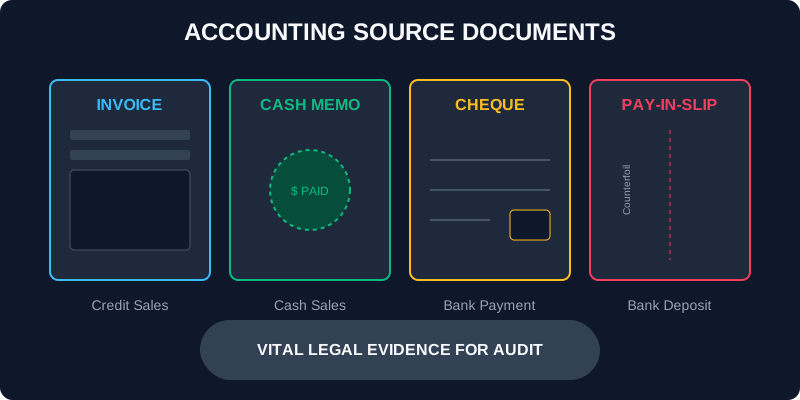
The most common source documents which provide this financial information are:
- Invoice: An invoice is a document which is prepared when one person sells goods to another. It generally contains the names of the seller and the customer, the date, and description of goods.
- Cash Receipt: When cash is received, a receipt is issued to the person paying the cash. It is prepared in duplicate by the cashier.
- Counter-foil of Pay-in-slip: Standard forms issued by banks for depositing cash or cheques. The "counterfoil" is returned to the depositor as an acknowledgment.
- Cheque: A written instrument drawn by the depositor. Details of the payment are recorded on the counterfoil.
- Cash Memo: Issued when sales are made on a cash basis.
Format of a Journal
The following is the standard specimen format of a Journal. Every student must know how to draw this!
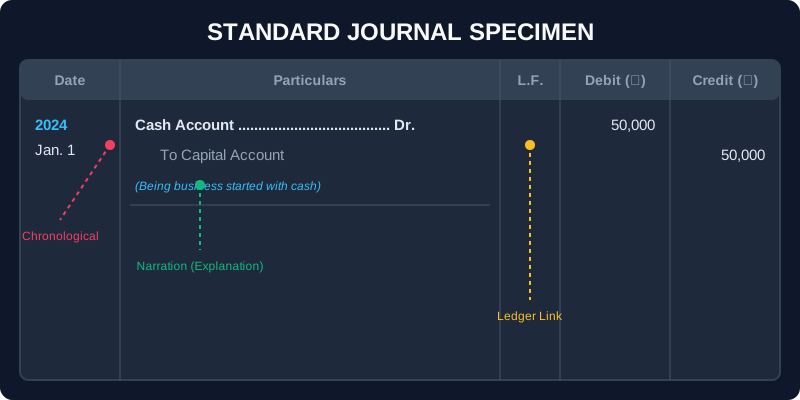
Explanation of the Columns of a Journal
The journal is sub-divided into five distinct columns:
- Date Column: Year, month, and date are written. Provides a chronological record.
- Particulars Column:
- (a) The Debit Account: Written on the first line with 'Dr.' at the extreme right.
- (b) The Credit Account: Written on the next line preceded by 'To' (indented).
- (c) The Narration: A brief explanation in brackets ( ) started with 'Being' or 'For'.
- Ledger Folio (L.F.) Column: Records the page number in the ledger where the entry is posted.
- Debit and Credit Amount Columns: Values for both aspects are recorded side by side.
4.5 Advantages of a Journal
Maintaining a journal gives the following crucial advantages:
- Transactions recorded date-wise: Reduces the chances of omitting a transaction.
- Process of classification at convenience: Posting into the ledger can be scheduled later.
- Ensures double-entry rules are followed: Arithmetical accuracy check via totaling columns.
- Reliable evidence: Courts regard the evidential quality of a journal highly.
- Sub-division enables division of labour: Multiple specialized journals allow several accountants to work.
- Detection of arithmetical errors: Quick indication if totals do not tally.
- Provides primary source-data: Directly written based on source vouchers.
- Forwarding of balances: Opening journal entries help carry forward last year's balances.
- Transfer in accounts: Facilitates moving amounts between accounts.
4.6 Limitations of a Journal
While essential, it does suffer from limitations:
- Long and unwieldy: If there are too many daily transactions.
- Daily cash balance not possible: Requires a separate Cash Book.
- Difficult to locate a transaction: If the exact date is forgotten.
- Time-consuming posting: Manual posting of every transaction is tedious.
4.7 The Journalising Process
The physical process of recording a business transaction in the Journal in a systematic manner is called Journalising.
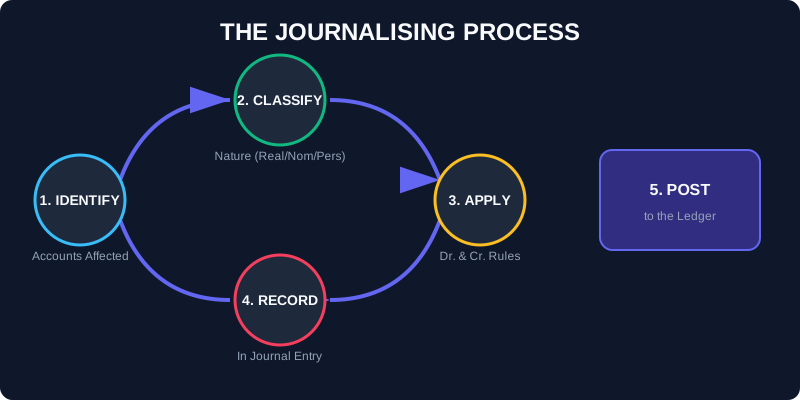
"The process of recording a transaction in a Journal is called Journalising the transaction."
— Meigs and Meigs and Johnson
4.8 Steps in Journalising
Follow these steps for every transaction:
- Identify the accounts involved.
- Determine the nature of accounts (Real, Personal, or Nominal).
- Ascertain the applicable Rule of debit and credit.
- Find which account is to be Debited and which Credited.
- Fill the Date Column.
- Write the Debit Account on the first line with 'Dr.'
- Write the Credit Account on the next line preceded by 'To'.
- Write the Narration in brackets.
- Draw a horizontal line below the narration.
- Leave L.F. blank until posting.
- Handle Compound Entries by listing all debits before credits.
📌 POINTS TO REMEMBER
• Use exact titles: Use standardized titles like 'Building Account' instead of 'Office Building Purchase Account'.
• Carrying forward totals: Use "Total Carried Forward" (c/f) at the bottom and "Total Brought Forward" (b/f) at the top of the next page.
4.9 Rules of Double Entry System
(A) Traditional Approach (British Approach)
Accounts are divided into three main categories. Let's look at the first one:
-
Personal Accounts: These represent the accounts related to individuals, firms, societies, clubs, hospitals, etc. Personal accounts are further classified as follows:
- (a) Natural personal accounts: These accounts relate to actual human beings. For example: Gurjit's Account, Anil's Account, Richard's Account, etc.
- (b) Artificial personal accounts: These relate to artificial persons, such as accounts of firms, clubs, companies, schools, colleges, universities, hospitals, government offices, municipal corporations, improvement trusts, banks, etc.
- (c) Representative personal accounts: Sometimes, special accounts are opened to represent indirectly a group of persons. These are called 'Representative Personal Accounts'. Suppose a firm has not paid wages to its fifty workers. The amount payable to the workers will be totalled and recorded under one single account known as the 'Wages Outstanding Account' or 'Wages Payable Account'. Similarly, there may be 'Prepaid Expenses Account', 'Accrued Income Account', etc.
-
Real Accounts: Real accounts relate to properties and assets, and they may be divided into two parts:
- (a) Tangible real accounts: These accounts relate to those assets which can be touched, felt, measured, purchased, sold, etc. For example: Plant Account, Equipment Account, Building Account, Cash Account, Furniture Account, Stock Account, etc.
- (b) Intangible real accounts: These accounts relate to those assets which are difficult to touch in a physical sense but hold value that can be measured in terms of rupees. For example: Goodwill, Copyrights, Trademarks, Patent rights, etc.
-
Nominal Accounts: These accounts relate to business expenses, losses, gains, and incomes.
- For example: Salaries Account, Wages Account, Loss of goods by fire Account, Interest Received Account, Sales Account, Purchase Account, Commission Received Account, etc.
Rules of Debit & Credit under Traditional Approach
Here are the fundamental rules applied to each account type:
- Personal Accounts: Debit the receiver (of benefit), and Credit the giver (of benefit).
- Real Accounts: Debit what comes in, and Credit what goes out.
- Nominal Accounts: Debit all expenses and losses, and Credit all incomes and gains.
📊 RULES UNDER TRADITIONAL APPROACH AT A GLANCE
| Sl. No. | Types of Accounts | Examples | Rules for Debit | Rules for Credit |
|---|---|---|---|---|
| 1. | Personal Accounts | (a) Natural: Ram's A/c. (b) Artificial: Raymond Mill's A/c. (c) Representative: Wages Outstanding A/c. | Debit the receiver of benefit | Credit the giver of benefit |
| 2. | Real Accounts | (a) Tangible: Plant A/c, Building A/c. (b) Intangible: Goodwill A/c. | Debit what comes in | Credit what goes out |
| 3. | Nominal Accounts | (a) Expenses: Wages A/c. (b) Losses: Loss by Fire A/c. (c) Profit & Gains: Profit on Sale A/c. | Debit all losses and expenses | Credit all gains and incomes |
(B) Modern Approach (American Approach)
Under this system, all accounts are divided into six distinct categories: (1) Assets, (2) Liabilities, (3) Capital, (4) Expenses & Losses, (5) Revenue (i.e., gains and incomes), and (6) Contra.
These six categories of accounts are also recognized as the 'elements of accounting'.
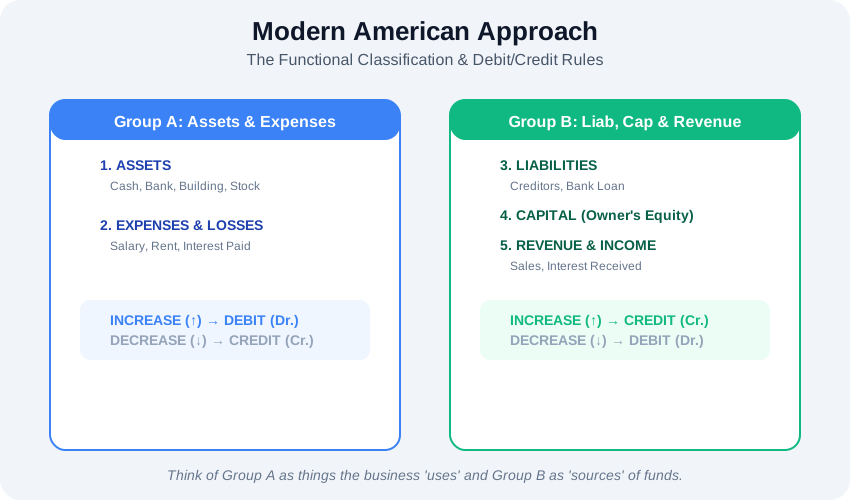
Kinds of Accounts under the Modern Approach:
- Assets: Cash, Bank, Debtors, Stock, Land & Buildings, Plant & Machinery, Furniture, Goodwill, Prepaid Expenses, etc.
- Liabilities: Creditors, Bills Payable, Borrowings, Bank loan, Outstanding expenses, etc.
- Capital: It relates to the Capital Account and Drawings Account.
- Revenue: Bad debts recovered, Interest received, Commission received, Sales, Rent received, etc.
- Expenses & Losses: Salaries, Wages, Carriage, Postage, Stationery, Advertisement, Rent, Bad debts, Purchases, etc.
- Contra accounts: Provision for bad debts, Provision for depreciation, Sales return, Purchases return.
📊 Rules at a Glance under Modern Approach
| Sl. No. | Name of the Account | Debit | Credit |
|---|---|---|---|
| 1. | Assets Account | Increase | Decrease |
| 2. | Liabilities Account | Decrease | Increase |
| 3. | Capital | Decrease | Increase |
| 4. | Revenue | Decrease | Increase |
| 5. | Expenses & Losses | Increase | Decrease |
| 6. | Provision Accounts | Decrease | Increase |
📌 POINTS TO REMEMBER (Bridging the Two Approaches)
• All nominal accounts under the traditional approach cover revenue, expenses, and losses under the modern approach.
• All real accounts under the traditional approach are covered under assets in the modern approach.
• Assets under the modern approach also include the personal accounts of debtors, advances, prepaid, and accrued income.
• All personal accounts of the traditional approach are covered under liabilities and capital under the modern approach.
• The Golden Rule of Outcomes: Application of the rules of debit and credit under both approaches will give the exact same trading results!
4.10 Analysis of Important Transactions
Now that we know the rules, let's look at how specific, common business transactions are analyzed and journalised:
1. Capital and Drawings
The Capital account and Drawings account are two accounts that directly belong to the proprietor.
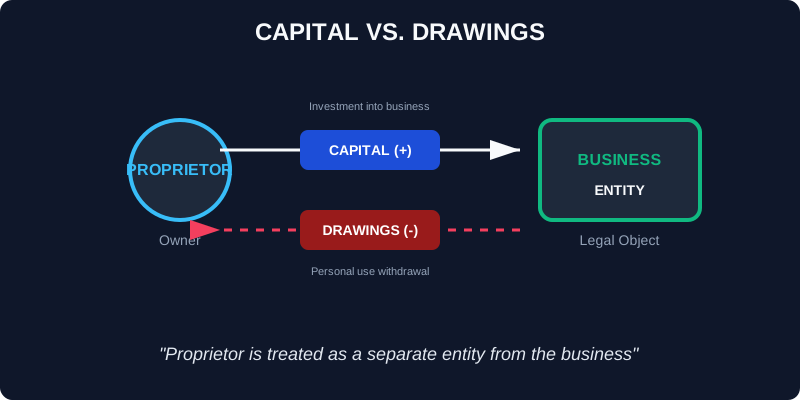
- Capital: When the proprietor invests cash or any other asset into the business, his capital account is credited. It is a liability of the business towards the businessman. It is a personal account.
- Drawings: On the other hand, when cash or any other item of the business is withdrawn by the proprietor for personal use, his Drawings Account is debited. The drawings account is also a personal account of the proprietor. This account is maintained for a year only to keep track of total withdrawals made by the proprietor during that particular year. At the end of the year, this drawings account is closed by transferring its balance to the Capital Account.
[!TIP]
📝 Practice Lab: ILLUSTRATION 5 (Journalising Capital & Drawings)
Let's look at a comprehensive example focusing purely on capital injections and personal drawings.
Question: Journalise the following transactions for Sahiba:
- Jan. 1: Sahiba started business with cash ₹ 3,00,000.
- Jan. 3: Cash withdrawn by Sahiba for personal use ₹ 40,000.
- Jan. 7: Additional capital introduced into business ₹ 50,000.
- Jan. 10: Sahiba paid the tuition fees of her daughter from the business ₹ 12,000.
- Jan. 15: Furniture of the business withdrawn by proprietor for personal use ₹ 24,000.
- Jan. 17: Goods withdrawn by Sahiba for personal use ₹ 9,500.
- Jan. 19: Life insurance premium paid ₹ 4,000.
- Jan. 21: Income tax paid ₹ 6,500.
SOLUTION: Books of Sahiba - Journal
| Date | Particulars | L.F. | Debit Amount (₹) | Credit Amount (₹) |
|---|---|---|---|---|
| 2016 | ||||
| Jan. 1 | Cash Account ........................................................... Dr. | 3,00,000 | ||
| To Capital Account | 3,00,000 | |||
| (Being the business started with cash) | ||||
| Jan. 3 | Drawings Account ................................................... Dr. | 40,000 | ||
| To Cash Account | 40,000 | |||
| (Being the cash withdrawn for personal use) | ||||
| Jan. 7 | Cash Account ........................................................... Dr. | 50,000 | ||
| To Capital Account | 50,000 | |||
| (Being additional capital introduced in cash) | ||||
| Jan. 10 | Drawings Account ................................................... Dr. | 12,000 | ||
| To Cash Account | 12,000 | |||
| (Being the tuition fees of daughter paid from the business) | ||||
| Jan. 15 | Drawings Account ................................................... Dr. | 24,000 | ||
| To Furniture Account | 24,000 | |||
| (Being furniture withdrawn by proprietor) | ||||
| Jan. 17 | Drawings Account ................................................... Dr. | 9,500 | ||
| To Purchases Account | 9,500 | |||
| (Being goods withdrawn for personal use) | ||||
| Jan. 19 | Drawings Account ................................................... Dr. | 4,000 | ||
| To Cash Account | 4,000 | |||
| (Being life insurance premium paid in cash) | ||||
| Jan. 21 | Drawings Account ................................................... Dr. | 6,500 | ||
| To Cash Account | 6,500 | |||
| (Being Income tax paid in cash) | ||||
| Total | 4,46,000 | 4,46,000 |
Crucial Rule to Remember: Whenever goods go out of the business for any reason other than sales and purchases return (like withdrawing goods for personal use, giving them away as free samples, or loss by fire), the 'Purchases Account' is credited to reduce the total purchases balance!
2. Purchase and Sale Transactions
The guidelines for purchase and sale transactions, which may occur in the business in different forms, are given below:
(a) Purchase and Sale of Goods:
It is very common, especially in trading and manufacturing businesses, to purchase and sell goods. When goods are purchased, the 'Purchase Account' is opened, and on the sale of goods, the 'Sale Account' is opened. It should always be borne in mind that the 'Purchases Account' and 'Sales Account' are opened only in the case of the purchase and sale of goods.
(b) Purchase and Sale of Investments and Other Assets:
When investments (Shares, Debentures, etc.) and other assets (plant, building, furniture, etc.) are bought or sold, the purchase account and sales account are not opened. The purchase of assets and investments will increase the amount of those relevant items, hence the specific Asset/Investment Account is debited. The sale of assets and investments will decrease the amount of those relevant items, hence the Asset/Investment Account is credited.
Quick Test: Which Account Do I Open?
Example: Which of the three accounts, namely Purchase, Sale, or Asset (other than cash), will be opened in the following cases?
| Sl. No. | Transactions | Name of Account |
|---|---|---|
| 1. | Goods amounting to ₹ 5,000 bought from Hari | Purchase Account |
| 2. | Goods sold to Jacob worth ₹ 3,000 | Sales Account |
| 3. | Plant sold to Gautam worth ₹ 9,000 | Plant Account (Asset) |
| 4. | Building purchased for cash ₹ 10,00,000 | Building Account (Asset) |
| 5. | A furniture merchant sold furniture for ₹ 15,000 | Sales Account (Furniture is their "goods"!) |
| 6. | Shares of A Ltd., sold for ₹ 4,000 | Investment Account or Shares Account |
| 7. | Debentures of B Ltd., sold for ₹ 9,000 | Investment Account or Debentures Account |
| 8. | Ten typewriters purchased by Typewriter dealer | Purchase Account (Typewriters are their "goods"!) |
3. Cash/Credit Transactions
There may be cash and credit transactions in the business. If cash is paid or received while dealing in business, it is called a 'cash transaction', but where payment or receipt is postponed to some future date, it is called a 'credit transaction'.
When there is a credit transaction in respect of the purchase or sale of goods or assets, the personal account involved in the transaction is always recorded.
- For example: Goods purchased from M/s. Raja Stores on credit. In this case, M/s. Raja Stores is a supplier of goods to whom the business owes the purchase price. Since it is a credit transaction, the account of M/s. Raja Stores must be opened in the books.
- Conversely: If the payment is made immediately at the time of taking the delivery of goods, the personal account concerned is not opened.
Read carefully, the following transactions:
- (i) Purchased goods for ₹ 1,200 in cash. (This is a Cash transaction)
- (ii) Purchased goods for ₹ 1,200. (This is treated as a Cash transaction since no name is given)
- (iii) Purchased goods for ₹ 1,200 from Arun. (This is a Credit transaction since a name is given and cash is not mentioned!)
- (iv) Purchased goods for ₹ 1,200 from Arun in cash. (Specifically cash ➔ Cash transaction)
- (v) Purchased goods for ₹ 1,200 from Arun on credit. (Specifically credit)
- (vi) Purchased goods for ₹ 1,200 on credit. (Credit transaction, supplier name unknown)
Here is exactly how you analyze them:
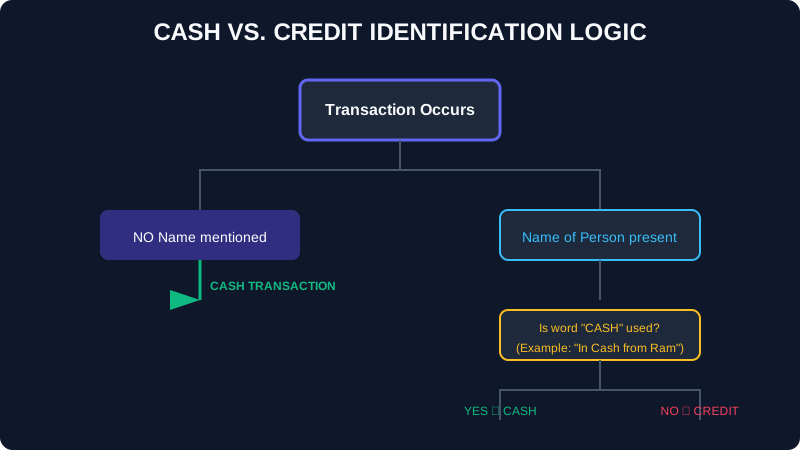
- Transactions (i) and (iv) are crystal clear, as it has been specifically stated that purchases have been made in cash. Thus, the entry is:
- Purchases A/c .......................... Dr. 1,200
- To Cash A/c. 1,200
- Transactions (ii) and (iii) are not specific as to whether the purchases are for cash or on credit. However, transaction (ii) does not mention any name of the supplier; therefore, it legally implies that the purchases are for cash. Similarly, transaction (iii) mentions the name of the supplier but is silent regarding cash—it implies that purchases are on credit! Thus, the entry for transaction (iii) is:
- Purchases A/c .......................... Dr. 1,200
- To Arun 1,200
- Transactions (v) and (vi) are clear that purchases have been made on credit, but in (vi) the name of the supplier is not given. Thus, the entry for transaction (vi) is:
- Purchases A/c .......................... Dr. 1,200
- To Creditor / Supplier A/c. 1,200
[!TIP]
📝 Practice Lab: ILLUSTRATION 6 (Cash vs. Credit Mastery)
Question: Journalise the following transactions in the books of Kanwar Pal:
- Jan. 1: Purchased goods for ₹ 35,000 in cash.
- Jan. 3: Purchased goods for ₹ 30,000.
- Jan. 7: Purchased goods for ₹ 25,000 in cash from Karanvir.
- Jan. 10: Purchased goods for ₹ 21,000 from Karamjit on credit.
- Jan. 14: Purchased goods for ₹ 20,000 from Kewal.
- Jan. 17: Purchased goods for ₹ 18,000 on credit.
- Jan. 20: Cash purchases ₹ 15,000.
SOLUTION: Books of Kanwar Pal - Journal
| Date | Particulars | L.F. | Debit Amount (₹) | Credit Amount (₹) |
|---|---|---|---|---|
| 2016 | ||||
| Jan. 1 | Purchases Account ............................................... Dr. | 35,000 | ||
| To Cash Account | 35,000 | |||
| (Being goods purchased for cash) | ||||
| Jan. 3 | Purchases Account ............................................... Dr. | 30,000 | ||
| To Cash Account | 30,000 | |||
| (Being goods purchased for cash) | ||||
| Jan. 7 | Purchases Account ............................................... Dr. | 25,000 | ||
| To Cash Account | 25,000 | |||
| (Being goods purchased for cash) | ||||
| Jan. 10 | Purchases Account ............................................... Dr. | 21,000 | ||
| To Karamjit | 21,000 | |||
| (Being goods purchased on credit) | ||||
| Jan. 14 | Purchases Account ............................................... Dr. | 20,000 | ||
| To Kewal | 20,000 | |||
| (Being goods purchased on credit) | ||||
| Jan. 17 | Purchases Account ............................................... Dr. | 18,000 | ||
| To Creditors Account | 18,000 | |||
| (Being goods purchased on credit) | ||||
| Jan. 20 | Purchases Account ............................................... Dr. | 15,000 | ||
| To Cash Account | 15,000 | |||
| (Being goods purchased for cash) | ||||
| Total | 1,64,000 | 1,64,000 |
4. Treatment of payment on personal/expenses account:
When a payment is made to a person against an amount specifically due to him, the personal account of the creditor should be debited. However, if the payment is being made to a person representing a business expenditure (like a salary or rent), then the particular expenditure (nominal) account should be debited!
For example: (i) Paid ₹ 500 to Varun on account; (ii) Paid ₹ 500 to Varun for his salary.
- In transaction (i), the entry is:
- Varun ......................................... Dr. 500
- To Cash A/c. 500
- In transaction (ii), the entry is:
- Salary A/c. ................................ Dr. 500
- To Cash A/c. 500
5. Treatment of receipt on personal/income account:
Similarly, when an amount is received from a person against an amount recoverable from him (like a past debt), the personal account of the debtor should be credited. However, if the amount received represents business income (like commission or rent), then the particular income (nominal) account should be credited.
For example: (i) Received ₹ 800 from Tarun on account; (ii) Received ₹ 800 from Tarun as commission.
The entries are:
- For (i):
- Cash A/c. ................................... Dr. 800
- To Tarun 800
- For (ii):
- Cash A/c. ................................... Dr. 800
- To Commission A/c. 800